Mostrando entradas con la etiqueta Sociology. Mostrar todas las entradas

viernes, 24 de octubre de 2014

David Glass

Born: 2 January 1911 London, England
Died: 23 September 1978

was an eminent English sociologist and was one of the few sociologists elected to the Royal Society. He is also one of the very few people to be elected both Fellow of the British Academy and Fellow of the Royal Society. He was professor of sociology at the London School of Economics, 1948-1978.

From 1932-1940 he was a research assistant to William Beveridge and statistician, Arthur Bowley.
In 1935 he was a research assistant with Lancelot Hogben in the department of Social Biology at the LSE. At this time he came into contact with R.R. Kuczynski. After Hogben's departure and the closing of the department in 1937, he was heavily involved in founding the Population Investigation Committee (PIC).
In 1948 he became professor. and from 1961-1978 he was Martin White professor of sociology at the London School of Economics.
He died in 1978 from a coronary thrombosis and was survived by his wife Ruth Glass, the urban sociologist.

Positions held

  • Chairman, Population Investigation Committee
  • President, British Society for Population Studies
  • Honorary President, International Union for Scientific Study of Population
  • Member, International Statistical Institute
  • FBA, 1964
  • FRS, 1971
  • Foreign Honorary Member, American Academy of Arts and Sciences, 1971
  • Foreign Associate, National Academy of Sciences (USA), 1973 

Publications

  • The Town in a Changing World, 1935
  • The Struggle for Population, 1936
  • Population Policies and Movements in Europe, 1940
  • (ed) Introduction to Malthus, 1953
  • (ed) Social Mobility in Britain, 1954
  • (with Eugene Grebenik) The Trend and Pattern of Fertility in Great Britain, 1954
  • (ed) The University Teaching of Social Sciences: Demography, 1957
  • Latin American Seminar on Population: Report, 1958
  • Society: Approaches and Problems for Study, 1962 (co-ed)
  • Differential Fertility, Ability and Educational Objectives, 1962
  • (ed jtly), Population in History, 1965
  • (ed jtly) Population and Social Change, 1972
  • Numbering the People, 1973
  • (with P. Taylor) Population and Emigration, 1976
He was an editor of the journals Population Studies and British Journal of Sociology.

Harriet Martineau

Born: 12 June 1802 Norwich, England
Died: 27 June 1876 (aged 74) Ambleside, England

Was an English social theorist and Whig writer, often cited as the first female sociologist.
Martineau wrote many books and a multitude of essays from a sociological, holistic, religious, domestic, and perhaps most controversially, feminine perspective; she also translated various works from Auguste Comte. She earned enough to be supported entirely by her writing, a rare feat for a woman in the Victorian era. A young Princess Victoria, (later Queen Victoria), enjoyed reading Martineau's publications. The queen invited Martineau to her coronation in 1838—an event which Martineau described, in great and amusing detail, to her many readers. Martineau said of her own approach to writing: "when one studies a society, one must focus on all its aspects, including key political, religious, and social institutions". She believed a thorough societal analysis was necessary to understand women's status under men.

The novelist Margaret Oliphant said "as a born lecturer and politician she [Martineau] was less distinctively affected by her sex than perhaps any other, male or female, of her generation." While she was commonly described as having a masculine intellect and body, Martineau introduced feminist sociological perspectives into her writing on otherwise overlooked issues such as marriage, children, domestic and religious life, and race relations.

Legacy

She left an autobiographical sketch to be published by the Daily News, in which she wrote:

"Her original power was nothing more than was due to earnestness and intellectual clearness within a certain range. With small imaginative and suggestive powers, and therefore nothing approaching to genius, she could see clearly what she did see, and give a clear expression to what she had to say. In short, she could popularize while she could neither discover nor invent."
In 1877 her autobiography was published. It was rare for a woman to publish such a work, let alone one secular in nature. Her book was regarded as dispassionate, "philosophic to the core" in its perceived masculinity, and a work of necessitarianism. She deeply explored childhood experiences and memories, expressing feelings of having been deprived of her mother's affection, as well as strong devotion to her brother James Martineau, a theologian.
Anthony Giddens and Simon Griffiths argue that Martineau is a neglected founder of sociology, but that she is important today. She taught that study of the society must include all its aspects, including key political, religious and social institutions, and she insisted on the need to include the lives of women. She was the first sociologist to study such issues as marriage, children, religious life, and race relations. Finally, she called on sociologists to do more than just observe, but also work to benefit the society

Notable works: 
  •  Illustrations of Political Economy (1834)
  • Society in America (1837)
  • Deerbrook (1839)
  • The Hour and the Man (1839)

Anthony Giddens

Born: 8 January 1938 London, England
Known for: Structuration theory, The Third Way, Risk society

Is a english sociologist who is known for his theory of structuration and his holistic view of modern societies. He is considered to be one of the most prominent modern sociologists, the author of at least 34 books, published in at least 29 languages, issuing on average more than one book every year. In 2007, Giddens was listed as the fifth most-referenced author of books in the humanities.
Three notable stages can be identified in his academic life. The first one involved outlining a new vision of what sociology is, presenting a theoretical and methodological understanding of that field, based on a critical reinterpretation of the classics. His major publications of that era include Capitalism and Modern Social Theory (1971) and New Rules of Sociological Method (1976). In the second stage Giddens developed the theory of structuration, an analysis of agency and structure, in which primacy is granted to neither. His works of that period, such as Central Problems in Social Theory (1979) and The Constitution of Society (1984), brought him international fame on the sociological arena.
The most recent stage concerns modernity, globalisation and politics, especially the impact of modernity on social and personal life. This stage is reflected by his critique of postmodernity, and discussions of a new "utopian-realist" third way in politics, visible in the Consequences of Modernity (1990), Modernity and Self-Identity (1991), The Transformation of Intimacy (1992), Beyond Left and Right (1994) and The Third Way: The Renewal of Social Democracy (1998). Giddens' ambition is both to recast social theory and to re-examine our understanding of the development and trajectory of modernity.
Giddens served as Director of the London School of Economics 1997–2003, where he is now Emeritus Professor.

Work:

Giddens, the author of over 34 books and 200 articles, essays and reviews, has contributed and written about most notable developments in the area of social sciences, with the exception of research design and methods. He has written commentaries on most leading schools and figures and has used most sociological paradigms in both micro and macrosociology. His writings range from abstract, metatheoretical problems to very direct and 'down-to-earth' textbooks for students. Finally, he is also known for his interdisciplinary approach: he has commented not only on the developments in sociology, but also in anthropology, archaeology, psychology, philosophy, history, linguistics, economics, social work and most recently, political science. In view of his knowledge and works, one may view much of his life's work as a form of 'grand synthesis' of sociological theory.

miércoles, 15 de octubre de 2014

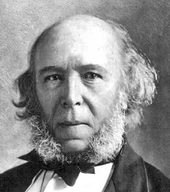
Herbert Spencer


Born: 27 April 1820
Died:  8 December 1903
School: Evolutionism, Positivism, Classical liberalism
Notable ideas: Social Darwinism, Survival of the fittest

Was an English philosopher, biologist, anthropologist, sociologist, and prominent classical liberal political theorist of the Victorian era.
Spencer developed an all-embracing conception of evolution as the progressive development of the physical world, biological organisms, the human mind, and human culture and societies.

Spencer read with excitement the original positivist sociology of Auguste Comte. A philosopher of science, Comte had proposed a theory of sociocultural evolution that society progresses by a general law of three stages. Writing after various developments in biology, however, Spencer rejected what he regarded as the ideological aspects of Comte's positivism, attempting to reformulate social science in terms of evolutionary biology. One might broadly describe Spencer's sociology as socially Darwinistic (though strictly speaking he was a proponent of Lamarckism rather than Darwinism).
The evolutionary progression from simple, undifferentiated homogeneity to complex, differentiated heterogeneity was exemplified, Spencer argued, by the development of society. He developed a theory of two types of society, the militant and the industrial, which corresponded to this evolutionary progression. Militant society, structured around relationships of hierarchy and obedience, was simple and undifferentiated; industrial society, based on voluntary, contractually assumed social obligations, was complex and differentiated. Society, which Spencer conceptualised as a 'social organism' evolved from the simpler state to the more complex according to the universal law of evolution. Moreover, industrial society was the direct descendant of the ideal society developed in Social Statics, although Spencer now equivocated over whether the evolution of society would result in anarchism (as he had first believed) or whether it pointed to a continued role for the state, albeit one reduced to the minimal functions of the enforcement of contracts and external defence.
Though Spencer made some valuable contributions to early sociology, not least in his influence on structural functionalism, his attempt to introduce Lamarckian or Darwinian ideas into the realm of sociology was unsuccessful. It was considered by many, furthermore, to be actively dangerous. Hermeneuticians of the period, such as Wilhelm Dilthey, would pioneer the distinction between the natural sciences (Naturwissenschaften) and human sciences (Geisteswissenschaften). In the United States, the sociologist Lester Frank Ward, who would be elected as the first president of the American Sociological Association, launched a relentless attack on Spencer's theories of laissez-faire and political ethics. Although Ward admired much of Spencer's work he believed that Spencer's prior political biases had distorted his thought and had led him astray. In the 1890s, Émile Durkheim established formal academic sociology with a firm emphasis on practical social research. By the turn of the 20th century the first generation of German sociologists, most notably Max Weber, had presented methodological antipositivism. However, it should be noted that Spencer's theories of laissez-faire, survival-of-the-fittest and minimal human interference in the processes of natural law had an enduring and even increasing appeal in the social science fields of economics and political science, and one writer has recently made the case for Spencer's importance for a sociology that must learn to take energy in society seriously.

Social Darwinism

For many, the name of Herbert Spencer would be virtually synonymous with Social Darwinism, a social theory that applies the law of the survival of the fittest to society; humanitarian impulses had to be resisted as nothing should be allowed to interfere with nature's laws, including the social struggle for existence.
Spencer's association with Social Darwinism might have its origin in a specific interpretation of his support for competition. Whereas in biology the competition of various organisms can result in the death of a species or organism, the kind of competition Spencer advocated is closer to the one used by economists, where competing individuals or firms improve the well being of the rest of society. Spencer viewed private charity positively so long as it did not encourage the procreation of the unworthy, as he believed in voluntary association and informal care as opposed to using government machinery.
Focusing on the form as well as the content of Spencer's "Synthetic Philosophy", it has recently been identified as the paradigmatic case of "Social Darwinism", understood as a politically motivated metaphysic very different in both form and motivation from Darwinist science.